How it works

One moment.
One connected lesson.

This walkthrough explains what a learner sees. It does not promise a fixed processing order or speed.

  1. 01

    Write

    Start with something that actually happened.

    Write the moment in English. The complete public-safe example stays together as one Story.

    Your Diary

    1. Yesterday I missed my usual bus, so I walked along the river before work.
    2. I bought a warm drink at a small cafe and wrote down three things I wanted to finish.
    3. In the evening, I prepared dinner, called my younger sister, and went to bed earlier than usual.
  2. 02

    Picture

    See the moment, not just the sentence.

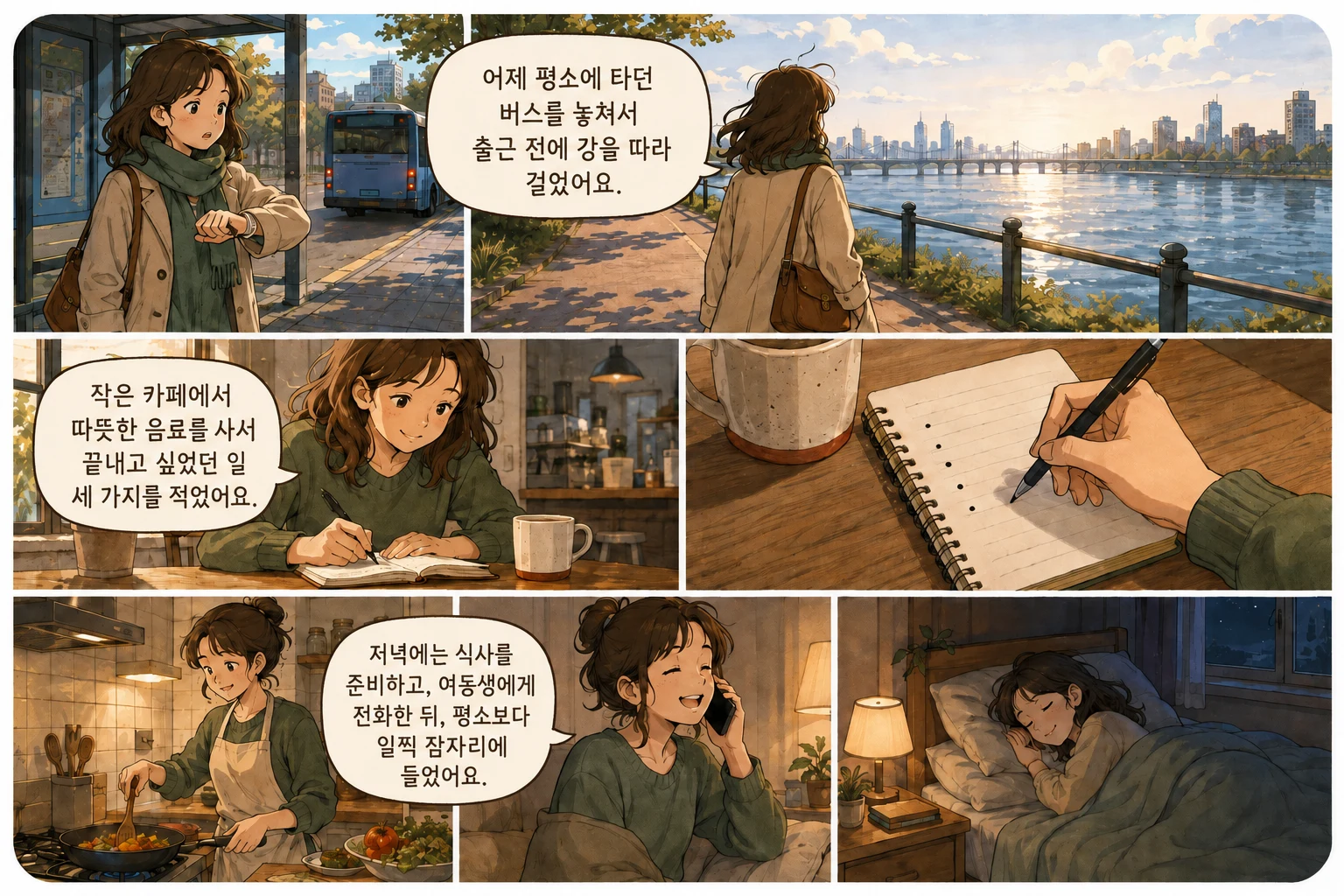
    A matching Cartoon Diary image gives the moment a visual place in memory.

    Cartoon Diary

    A single-page Cartoon Diary with three Korean diary bubbles, following a woman who misses her bus, walks beside a river, writes three tasks over a warm cafe drink, prepares dinner, calls her younger sister, and goes to bed early.

    A Cartoon Diary generated from this walkthrough's three Korean diary sentences.

  3. 03

    Korean Story

    Read the same moment in Korean.

    The three sentences remain in order so you can move between what you wrote and what you are learning.

    Your Korean Story

    1. 어제 평소에 타던 버스를 놓쳐서 출근 전에 강을 따라 걸었어요.
    2. 작은 카페에서 따뜻한 음료를 사서 끝내고 싶었던 일 세 가지를 적었어요.
    3. 저녁에는 식사를 준비하고, 여동생에게 전화한 뒤, 평소보다 일찍 잠자리에 들었어요.
  4. 04

    Grammar

    Notice the grammar inside your own story.

    Haru marks -아/어서 and -어요, with frequent forms folded into a quieter list.

    Grammar

    어제 평소에 타던 버스를 놓쳐서 출근 전에 강을 따라 걸었어요.

    -아/어서links a cause to what follows
    -어요polite spoken ending

    Frequent forms: -에 · -를 · -을 · -었

  5. 05

    Vocabulary

    Learn words where they already mean something.

    Words such as 평소, 버스, and 따라 stay attached to the sentence.

    Vocabulary

    어제Yesterday평소usual버스bus놓쳐missedbeforeriver따라along
  6. 06

    Phrases

    See how the sentence is held together.

    Phrases and predicates show the useful spans between a single word and the complete sentence.

    Phrases and predicates

    평소에 타던 버스
    my usual bus
    강을 따라
    along the river
    출근 전에
    before work
    평소에 타던 버스를 놓쳐서
    missed my usual bus
    출근 전에 강을 따라 걸었어요
    walked along the river before work
  7. 07

    Listen

    Hear the sentence at the pace you need.

    The control below changes only this illustrative waveform. No audio starts on its own.

    Listen

    어제 평소에 타던 버스를 놓쳐서 출근 전에 강을 따라 걸었어요.

    Illustrative waveform only. No voice sample is loaded.

  8. 08

    Ask

    Ask about the exact part that stopped you.

    Select a span, ask a focused question, and keep the answer beside the Story it came from.

    Ask about a selection

    평소에 타던 버스를 놓쳐서

    QuestionWhy does 놓쳐서 connect these two events?

    Answer-아/어서 links a cause to what follows. Here, 놓쳐서 means "because I missed the bus," which leads into the walk before work.

Ready to begin?

Start with one moment from your day.

Start free