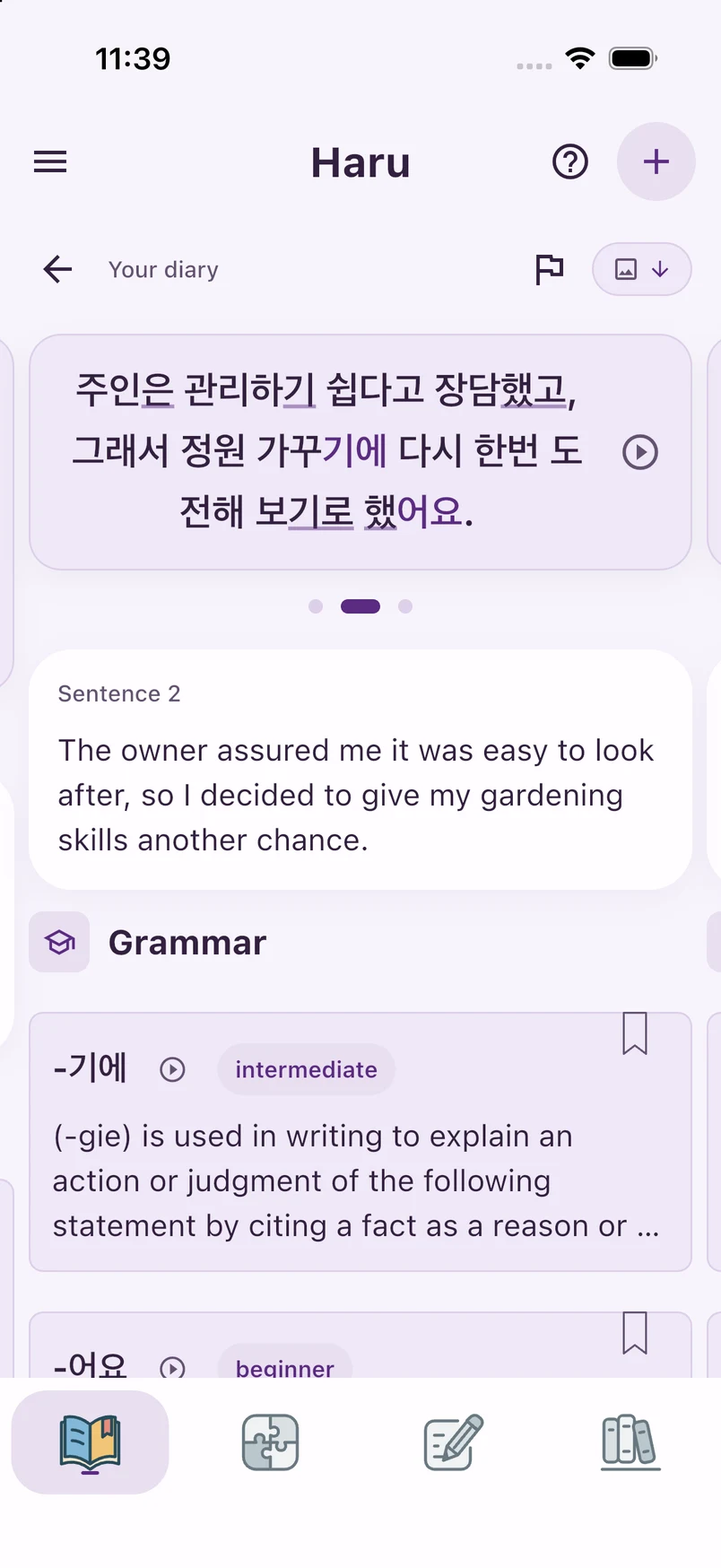
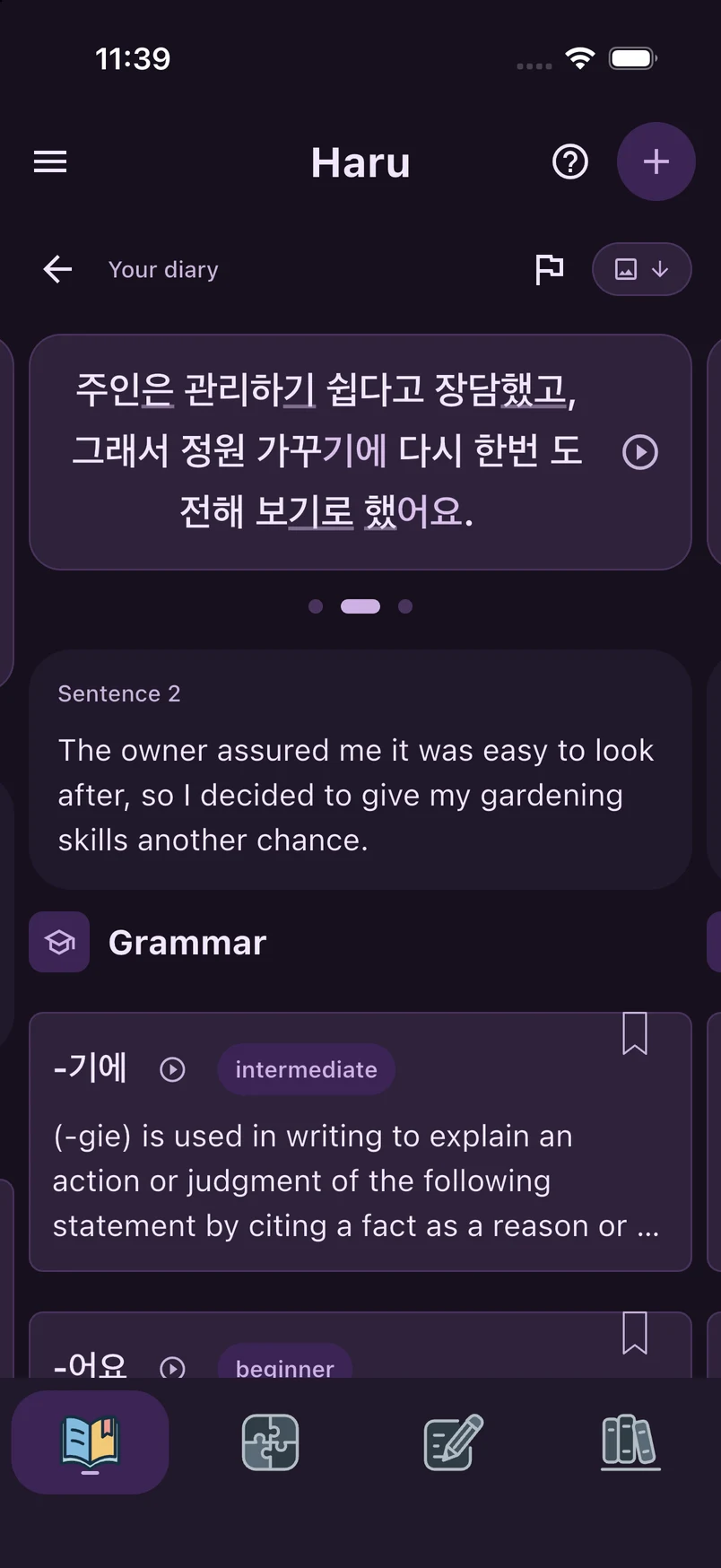
Actual app output · one sentence from a three-sentence diary.
One moment. A complete practice path.
01
Write
Begin with a few lines in English about a moment, a thought, or a plan.
02
Learn
Read the Korean and see words, grammar, and phrases in the context of your story.
03
Build
Choose a missing word, type it, or put a sentence back together. Try before checking the answer.
04
Practice
Try writing in Korean. Review the feedback and make another attempt.
05
Return
Save useful learning items and revisit them in your Library.
Your meaning, in natural Korean
Learn the expression, not the literal wording.
I decided to give my gardening skills another chance.
A literal rendering
정원 가꾸기 실력에 다시 한번 기회를 주기로 했어요.
Natural Korean · actual app output
정원 가꾸기에 다시 한번 도전해 보기로 했어요.
Here, “give my gardening skills another chance” becomes a natural Korean way to say “try gardening again.” Haru helps you learn the grammar, words, and phrases in that Korean expression, using the story you already know.
Literal wording shown for contrast. The natural Korean is an excerpt from the actual app result, recorded 8 Oct 2026. Results can vary.
With someone else’s sentence, you first have to work out what it means. With your own day, the meaning is already yours. So when Korean says it differently, you can connect the expression to a moment you already understand.
On Haru’s vocabulary cards, the paired English comes from your own sentence. You learn the Korean alongside the words you actually used.
Build a collection of expressions from your own experiences.
How it works
One small detour. A complete learning path.
Actual app output · recorded 8 Oct 2026
On my way home from my first design job in Portland, I ducked into a little shop to escape the rain and came out with a plant I hadn't planned to buy.
포틀랜드에서 첫 디자인 일을 마치고 집으로 돌아오는 길에 비를 피하려고 작은 가게에 들어갔다가, 살 계획도 없었던 식물을 하나 사서 나왔어요.
Grammar
-다가(-daga) indicates a flow where an action or state proceeds but changes to another action or state or stops midway.
Phrases and clauses
집으로 돌아오는 길에On my way home
The English, Korean, learning cards, and cartoon come from the same generated diary.
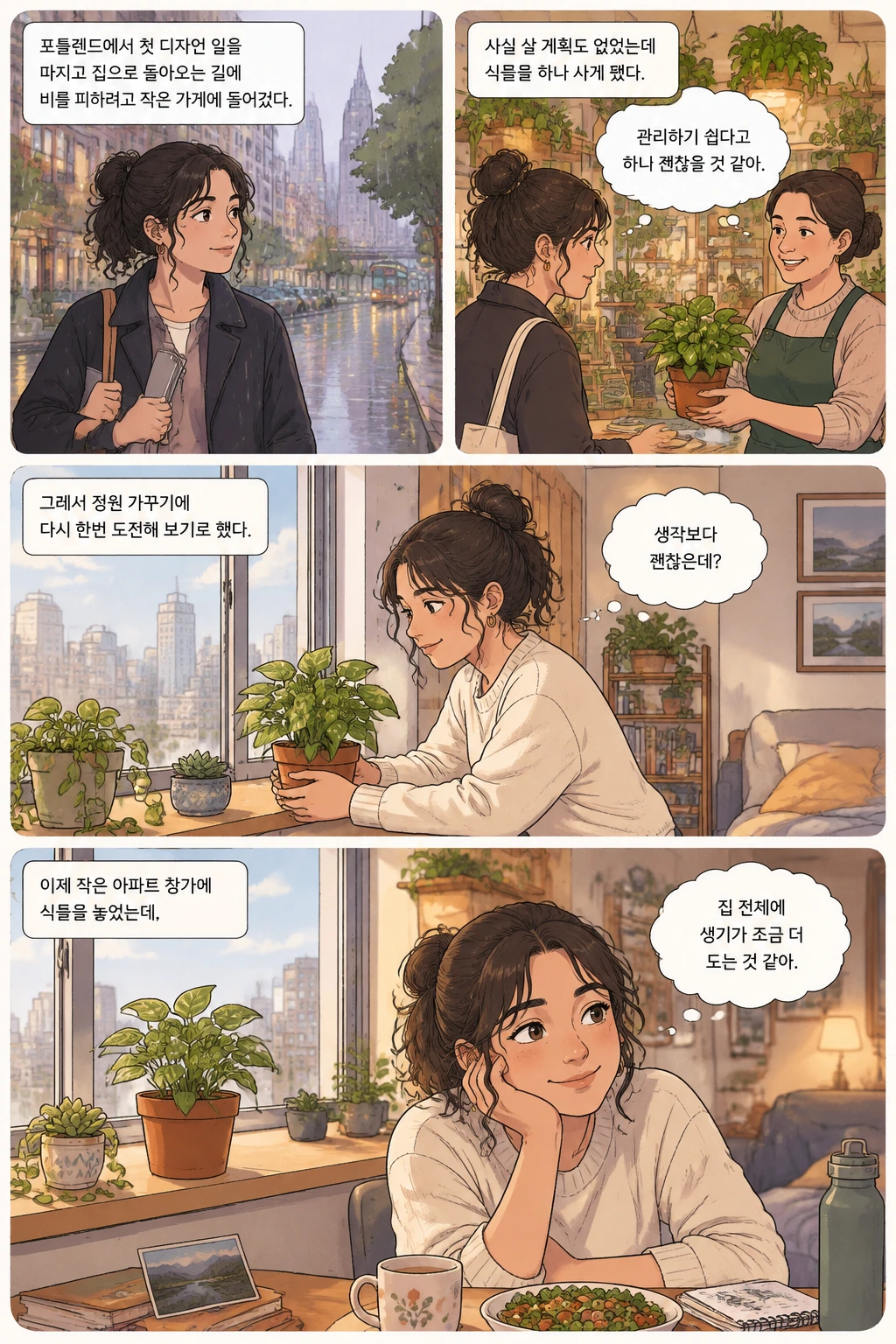
An optional cartoon illustrates the story you wrote. Keep the scene beside the language as you read, listen, and return to the moment.
Generated from your written story. Illustrations may vary.
Hear it in a version of your own voice.
With your consent, create an optional voice profile and listen to your Korean diary in an AI-generated version of your voice. Replay a sentence or adjust playback speed while you follow the text.
AI-generated listening audio, not a recording of you speaking Korean.
Actual cartoon generated from this fictional diary.
Where Haru fits
Bring your Korean learning into your own life.
Use Haru alongside a course, vocabulary review, and conversations with other people. Bring what you’re learning into stories you want to tell, then practice with language that comes from them.
Questions, answered
Before you begin.
Who makes Haru?
Haru is made by Beyond The Singularity.
Why not learn the word-for-word translation first?
You can, but you may need to learn a more natural expression later. Haru starts with the natural version. Word and grammar cards help you see the language inside it.
Is there only one natural way to say something?
No. Korean often has several natural ways to say the same thing. Haru shows you one that fits your story.
Do I need to write in Korean first?
No. Start your diary in English and learn from the Korean version. Practice is where you can try writing Korean yourself.
Does every English word match one Korean word?
No. Word order, grammar, and what is left unstated can differ. Look at the meaning of the whole expression in its sentence.
Do I have to clone my voice?
No. Creating a voice profile is optional and requires your consent.
Is the cartoon made from a photograph of me?
The cartoon illustrates your written story. It is not a photo-to-cartoon conversion or a promise to reproduce your appearance exactly.
Can Haru replace a course or conversation practice?
Haru focuses on learning and practicing Korean from personal stories. You can use it alongside a course and opportunities to speak with other people.
Are translations and learning content always correct?
AI-generated content can contain mistakes. A natural change of wording should preserve the intended meaning; it does not make an incorrect translation acceptable.
Where do I learn?
Learning takes place in the Haru app. This website explains the product and provides account and plan information. Store links appear when available.
Your next story
What would you like to say in Korean?
Start with a moment, a thought, or a plan.
Get Haru for iPhone, iPad and Android. Store availability and QR codes are on the Download page.